July 2024
The Habitable Worlds Observatory NASA's Next Flagship Astrophysics Mission
Artist interpretation of one of the concepts for the Habitable Worlds Observatory (HWO)
This concept of HWO has an unobstructed 6-meter inscribed diameter segmented primary mirror. The primary mirror is the first element of a three-mirror focusing assembly with the secondary mirror to the side of the incoming light beam. (This optical design is called a three-mirror anastigmatic, or TMA.)
Credit: NASA Goddard Space Flight Center Conceptual Image Lab
Introduction
In January 2023, NASA announced that it had selected the Habitable Worlds Observatory (HWO) as its next flagship astrophysics mission, with launch foreseen in the late 2030’s or early 2040’s. The primary goal of HWO is to search the spectra of habitable zone exoplanets for biosignatures that could be signs of life in the Universe. The mission addresses one of the most fundamental questions of astrophysics: Are We Alone?
During the past 18 months, scientists and engineers have begun to define the range of science that will be addressed by HWO and develop concepts for how the observatory will be built and operated. This article describes the nascent thinking as it stands in July 2024. The mission’s science goals and technical approach will continue to evolve through the 2020’s and the final design of HWO will be much different than what is presented here.
Before we start to discuss the HWO mission, it is useful to review the process by which NASA selects flagship astrophysics missions.
The Astronomy and Astrophysics Decadal Survey
Every ten years, the National Research Council of the United States National Academy of Sciences conducts a survey of the current state of a scientific field to identify research priorities and make recommendations for the coming decade. The decadal survey provides a consensus recommendation to U.S. governmental agencies for a 10-year plan for scientific missions, research facilities, and educational initiatives. The decadal survey is a multi-year process of meetings of topical panels and subcommittees, dedicated conferences, and direct community input in the form of white papers that summarize the state-of-the-art and concepts for future missions and facilities.
The scientific community takes the decadal survey process seriously and expends considerable effort developing white papers; a total of 573 science white papers were submitted to the Astronomy and Astrophysics decadal survey that was released in November 2021 and is referred to as “Astro2020”. Astro2020 is the sixth decadal review done for astronomy and astrophysics, as shown in the chart below.
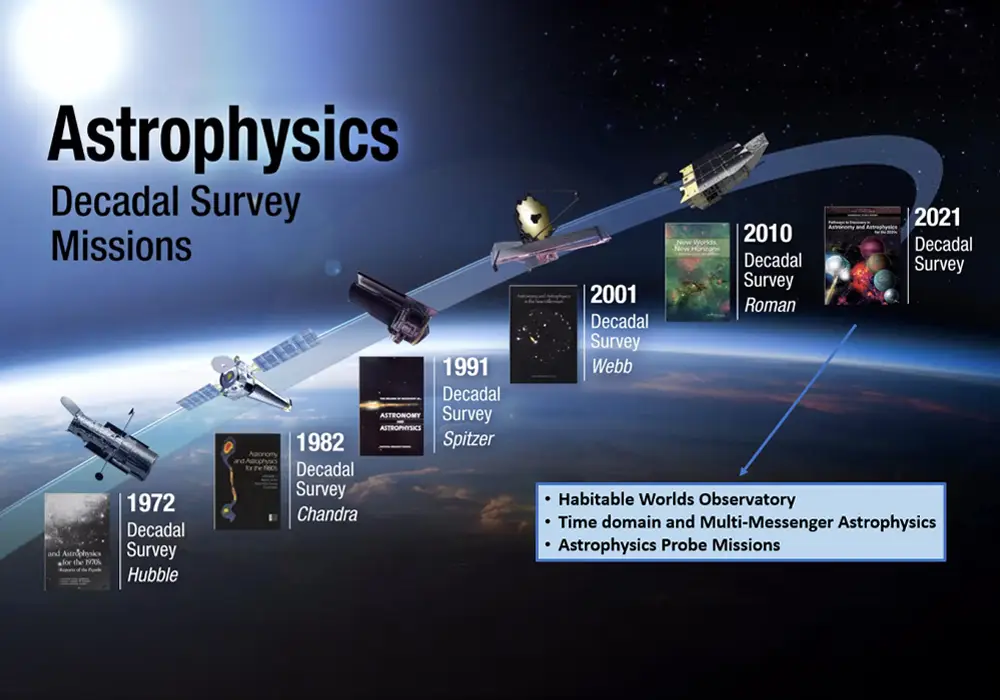
Astronomy & Astrophysics Decadal Surveys conducted by the U.S. National Academy of Science
The flagship astrophysics missions recommended by each decadal survey is listed.
The Habitable Worlds Observatory resulted from combining two mission recommendations made in Astro2020.
The Decadal Survey makes recommendations for both ground-based astronomy and space missions. This article focuses on the space mission portfolio.
As shown in the graphic above, the Astronomy & Astrophysics Decadal Surveys have resulted in the following flagship missions:
- Hubble Space Telescope ‐ 2.4-meter UV / optical / near infrared telescope launched in 1990 and operating in low Earth orbit. Hubble has a warm primary mirror (21° C, 70° F) and senses light from 0.1 to 1.8 µm.
- Hubble’s WFC3 instrument uses visible and infrared detectors produced by Teledyne: two 2051×4096 pixels CCDs and a 1024×1024 pixel short-wave infrared focal plane array (FPA).
- Chandra x-ray telescope ‐ 1.2-meter diameter observing soft x-rays, with energies of 0.1-10 keV. Launched in 1999 into a highly elliptical orbit, Chandra is still operational.
- Spitzer ‐ 0.85-meter infrared telescope launched in 2003 into an Earth-trailing orbit. The primary mirror was cooled to 5.5K during the 6-year primary mission during which it studied infrared light with wavelengths of 3.6 to 95 µm. During 2009-2020, after the liquid helium coolant supply was exhausted, the Warm Spitzer Mission continued to operate in the shortest wavelength bands (3.6 and 4.5 µm). Spitzer was decommissioned on January 30, 2020.
- James Webb Space Telescope ‐ 6.5-meter diameter primary mirror radiatively cooled to 50K to study the early universe in wavelengths from 0.6 to 28.3 µm. Launched in 2021 and operating in a halo orbit about Lagrange Point L2.
-
JWST uses infrared FPAs and focal plane electronics produced by Teledyne: 15 H2RG (2040×2040 pixel) short-wave and mid-wave infrared FPAs and 15 SIDECAR ASIC focal plane electronics are in three JWST instruments.
- Roman Space Telescope (RST) ‐ 2.4-meter primary mirror cooled to 265K to sense light from 0.48 to 2.3 µm with a 302 million pixel infrared focal plane mosaic. RST also has an advanced coronograph that suppresses host starlight by a factor of 200 million to image exoplanets with electron-multiplied CCDs (EMCCDs). RST is expected to launch by May 2027 and will operate in a halo orbit about Lagrange Point L2.
-
Teledyne supplied all of the infrared and visible FPAs used in RST’s instruments. The wide field infrared imager uses 18 H4RG-10 (4096×4096 pixel) shortwave infrared FPAs and the coronagraph imager uses three 1024×1024 pixel EMCCDs.
Astro2020 assessed four possible concepts for NASA’s next flagship astrophysics mission:
- Habitable Exoplanet Observatory (HabEx) ‐ telescope with a 4-meter primary mirror to image and study exoplanets as well as studying a broad range of galactic and extragalactic astrophysics.
- Large UV / Optical / IR Surveyor (LUVOIR) ‐ a very large telescope with either an 8-meter or 15-meter primary mirror to study exoplanets, cosmology & the structure of the universe, and better understand galaxy formation & evolution and star & planet formation.
- Lynx X-ray observatory ‐ 2-meter2 effective aperture to study soft x-rays with energies of 0.1 to 10 keV. Lynx will have a 50-fold increase in sensitivity compared to the Chandra X-ray observatory. Lynx is designed to observe the first supermassive black holes and understand the critical drivers of galaxy and stellar evolution, studying phenomena only evident at high energies.
- Origins Space Telescope ‐ a 5.9-meter diameter telescope cooled to 4.5K to measure the spectra of exoplanets in the 2.8 to 20 µm wavelength range, survey thousands of square degrees by imaging at 50 and 250 µm and make deep spectroscopic surveys over 25-588 µm wavelengths.
NASA combined the first two concepts, HabEx and LUVOIR, into HWO, which has been referred to as a “Super-Hubble” design. Observing wavelengths of light similar to those detected by the Hubble Space Telescope, HWO will have a mirror large enough (≥6-meter diameter) to find and study at least 25 potentially habitable worlds around other stars. While the primary goal of HWO is to find and study the biosignatures of Earth-like planets orbiting Sun-like (G-type) stars within 100 light-years of Earth, HWO will also study cosmic ecosystems: the origins and evolution of galaxies, from the cosmic webs of gas that feed galaxies to the formation of stars within galaxies.
The Approach to Designing, Building, and Operating HWO
The James Webb Space Telescope is a resounding success, but JWST suffered from significant cost and schedule overruns. A short history of JWST is as follows.
- In 1999, JWST (at that time called the Next Generation Space Telescope) was envisioned as a $1 billion mission with launch in 2007. As seen below, the $1B estimate was grossly under-costed.
- In 2001, JWST was given the highest ranking by the Decadal Survey to be NASA’s next flagship astrophysics mission.
- Cost growth led to a re-plan of the mission in 2005. The revised plan foresaw the life-cycle cost of JWST to be $4.5 billion with $3.5 billion for design, development, launch (in 2013), and commissioning and $1 billion for ten years of operations.
- Cost overruns and schedule delays continued and in July 2011, the U.S. Congress voted to cancel JWST. After an international outcry, in November 2011, Congress reversed plans to cancel JWST and instead capped additional funding to complete the project at $8 billion with launch in 2018.
- After issues arose during integration and test, JWST was further delayed, and costs continue to grow. When JWST was launched in December 2021, NASA’s total cost was calculated at $9.7 billion ($8.8 billion design and development, plus $0.9 billion for 5 years of operation). The European Space Agency’s cost is estimated at €700 million (~US$0.8B) and the Canadian Space Agency costs were about CA$200 million (~US$0.15B).
- The total international cost for JWST is about $10.7 billion (USD).
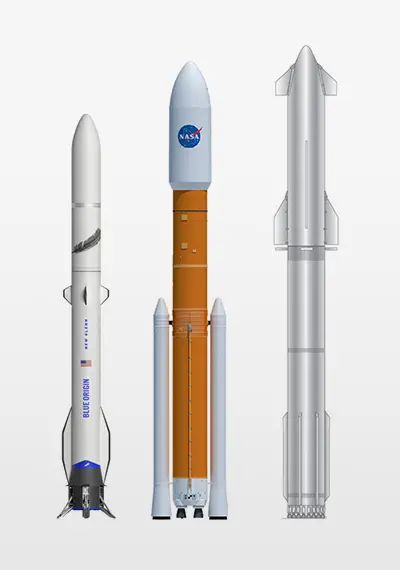
New generation of large rockets
Left - Blue Origin New Glenn, 98-m tall, 6.35-m fairing
Center - Space Launch System Block 2, 111-m tall, 8.4-m fairing
Right - SpaceX Starship, 121-m tall, 8.0-m fairing
Credit: Blue Origin, NASA, SpaceX
NASA learned from JWST that future space observatories must be developed, integrated, and launched with an approach that is much different than what was taken for JWST. The guiding principles that will be applied to HWO are:
- Utilize the new generation of big rockets to reduce system complexity.
- Three examples, shown above, are the Space-X Starship that has an 8-meter diameter fairing, the Space Launch System (SLS) Block 2 that has an 8.4-meter diameter fairing, and Blue Origin’s New Glenn which has a 6.35-meter diameter fairing.
- The new generation of big rockets enables more mass to be launched to Lagrange Point L2, with less complexity in the observatory design and deployment. System interfaces can be simplified with less coupling between interfaces.
- Telescope Evolution not Revolution.
- Utilize a segmented, scalable telescope.
- The scalability of a segmented mirror allows the mirror diameter to be modified as science and instrumentation requirements are matured.
- Add a baffle to protect from micrometeoroid impacts and enable a wider field of regard.
- Design for robotic servicing at Lagrange Point L2.
- Robotic servicing can enable instrumentation upgrades that utilize advanced technology such as superconducting photon counting detectors that measure the wavelengths of detected photons.
- Modularity of instruments enables clean interfaces that provide integration and test flexibility and reduces schedule risk.
- This was not done on JWST due to mass and volume limitations.
- Planned servicing reduces the cost and schedule of initial instrument development and optimizes the science per dollar cost.
- This is the approach that mountaintop observatories on Earth utilize, enabling new generations of instrumentation that incorporate the latest technology.
- Since JWST is not serviceable, its instruments had to include all foreseen capability, adding cost to the mission.
- Servicing increases mission life and tolerance to failure. A non-serviceable flagship mission, such as JWST, requires higher reliability and confidence.
- Servicing also removes depletion of thruster fuel as the cause of mission end. Most space missions reach end-of-life when thruster fuel is depleted.
- Design and build HWO with large margins.
- Having large science and technical margins from the start reduces architecture risk and minimizes the number of design and analysis iterations.
- Use a “build to schedule” philosophy.
- When HWO is fully approved as a mission, around 2030, NASA will fix the development schedule and will make schedule a level 1 requirement. Level 1 is something required for successful completion of the mission’s objectives. Level 1 is the highest level of requirement for a NASA mission.
- Conduct the HWO project like planetary science missions (which have strong constraints on launch dates due to planetary orbits).
- A major cause of cost overruns is the “marching army” cost that occurs when the development of space missions extends years beyond plan, as happened with JWST.
- Mature the architecture and technology fully before starting the development phase.
- This approach is very important to control costs.
- HWO will refine the mission architecture and undertake technology maturation during 2024-2030 before commencing full development and construction of the observatory.
- Reduce the risk of system and verification complexity by designing HWO to be a warm telescope with active technologies.
- A major cost driver of JWST was the cryogenic conditions for the telescope and instruments. Defining HWO to be a warm telescope, with primary mirror temperature of 270K to 290K (26 °F to 62 °F), greatly reduces system complexity and the risk of system verification.
- JWST was also designed to have passive stability, which has special challenges for design and verification. Instead, HWO will incorporate active technologies for wavefront sensing / control and optical alignment.
- Managing human factors throughout the mission lifecycle is critical to mission success.
- HWO needs to utilize the strong knowledge base established by the James Webb Space Telescope and the Roman Space Telescope. It is important to transition this knowledge before the retirement of key individuals in industry and government.
- Incorporate the right people, with the right skills, at the right time.
- Cultivate the next generation of engineers and scientists that will bring HWO to fruition.
In summary, the design, development, launch, and operation of HWO will incorporate the following principles that will control cost & schedule and minimize project risks.
- HWO will be a warm, segmented telescope with a baffle that operates at L2.
- HWO will be serviceable, with plans for future instrument upgrades.
- HWO will be launched by the new generation of large rockets.
- HWO will be built and launched to a strict schedule, with schedule held as a level 1 requirement.
- The HWO mission will not proceed to development until all technologies have been proven.
HWO Science – Searching for Signs of Life in the Universe
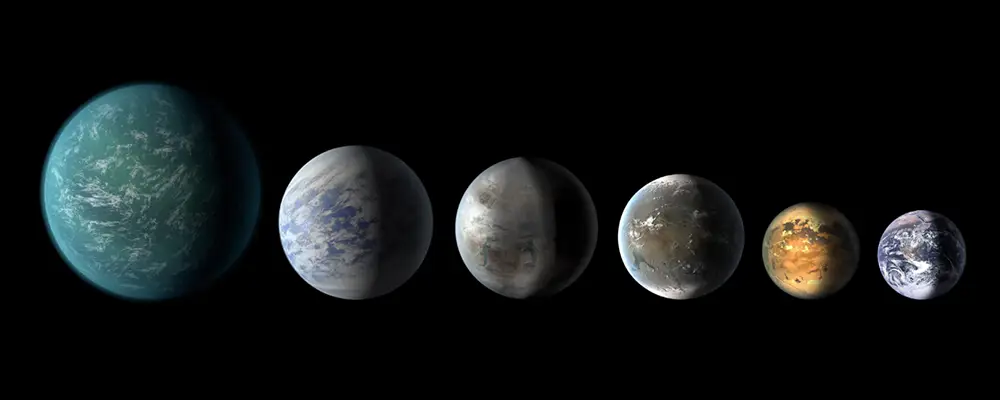
Artist's Concept of a Pantheon of Exoplanets that are similar to Earth
5 conceptual exoplanets plus Earth at the far right.
Credit: NASA
One of the most fundamental questions asked by humanity is: Are we alone? Is there intelligent life elsewhere in the Universe? Before we find signs of intelligent life, we first must find the signs of any kind of life, even at the lowest level (amoeba, bacteria).
While NASA continues to explore for signs of life in our solar system, life is most likely to be found on exoplanets, which are planets that orbit stars outside of our solar system. NASA has placed this question at the top of its list for the next flagship astrophysics mission after the Roman Space Telescope (2027 launch). NASA will address this question with a mission called the Habitable Worlds Observatory, abbreviated to HWO.
Astronomers look for signs of life by looking for biosignatures in the spectrum of the atmosphere of exoplanets. Biosignatures are molecules that typically only exist in non-equilibrium, meaning that there must be a lifeform that creates the molecules. Oxygen (O2), methane (CH4), and the vegetation red-edge (VRE) are biosignatures, especially if seen together in abundance. Water (H2O), carbon dioxide (CO2), and Rayleigh scattering are “habitability” signatures, meaning that the exoplanet can hold water in its liquid form and the keep the atmosphere warm on the surface. But habitability does not necessarily imply that life exists. Examples of biosignatures and habitability signatures can be seen in the reflected sunlight spectrum of the Earth’s atmosphere shown below.
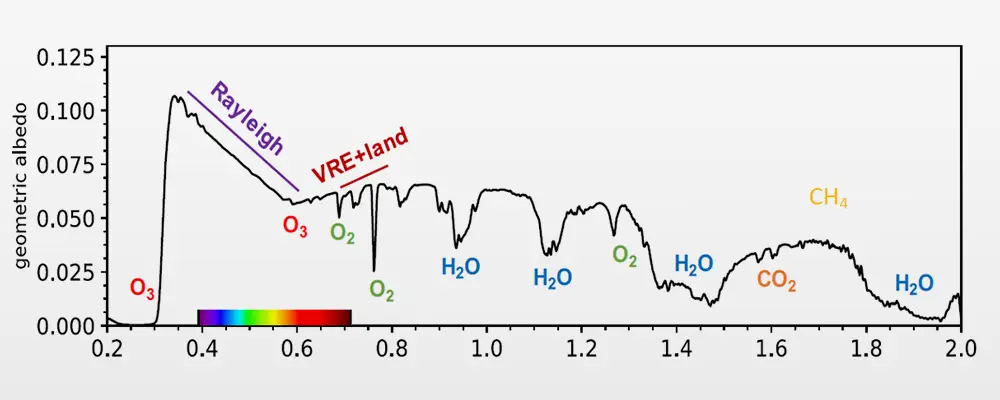
An average Earth spectrum created by the reflection of the light from our Sun
The spectrum ranges from the ultraviolet (UV) at 0.2 µm (200 nm) through the visible (shown by the color bar above 0.4 to 0.7 µm) and through the near infrared to 2.0 µm wavelength. Features that can be seen are ozone (O3) absorption in the ultraviolet, Rayleigh scattering from the Earth’s blue sky and the Earth’s vegetation red-edge (VRE). Features can also be seen for oxygen (O2), water vapor (H2O), carbon dioxide (CO2), and methane (CH4).
Credit: Edward Schwieterman presentation at the Sagan Summer Workshop, July 2023.
While the Habitable Worlds Observatory will be designed to undertake a wide range of scientific investigation, one of the most stringent science goals of HWO is to measure the biosignatures of nearby exoplanets to find signs of life outside of our Solar System on Earth-like planets orbiting Sun-like stars.
-
Most exoplanets discovered to date orbit around cooler M-type stars, the most common type of star in the Milky Way. But the exoplanets of M-stars are probably not hospitable to life since M-stars emit about 400 times the level of x-rays emitted by our Sun and M-type stars can have violent outbursts of gas. The increased x-ray irradiance and sporadic gas flows may strip exoplanets of their atmospheres and destroy life on exoplanets in the habitable zone of M-stars.
Determining the habitability of an exoplanet will come from measuring the spectrum of the exoplanet’s atmosphere that is due to reflection of the exoplanet’s host starlight. Ideally, we will find spectra that are similar to the Earth’s spectrum. But when measuring exoplanet spectra, we need to remember that the Earth’s atmosphere has evolved significantly over the Earth’s 4.6 billion history. The Earth has evolved through four different eons:
- 600 million years in the “Hadean” eon
- 1,500 million years in the “Archean” eon
- 2,000 million years in the “Proterozoic” eon
- 540 million years in the “Modern” eon
The “Hadean” eon name comes from Hades, the Greek god of the underworld. This name is apropos since during the Hadean eon, the Earth had hellish conditions with superheated lava on the Earth’s still molten surface. During the Hadean eon the Earth was subject to frequent impact events, one of which created the Earth’s Moon. The end of the Hadean eon is marked by a period of a few hundred million years called the Late Heavy Bombardment (LHB). During the LHB, a large number of asteroids and comets are hypothesized to have collided with the terrestrial planets (Mercury, Venus, Earth, Mars) and our Moon. The Earth was not hospitable to life during the Hadean eon.
The Earth’s atmosphere and its spectral signature for the last three eons are shown in the figure below. Time runs from top to bottom and the concentration of gases in the Earth’s atmosphere are plotted at left, with the reflected sunlight spectra plotted at right. The gases are plotted relative to their “column mass”. The column mass is the total mass of a gas measured from sea level up to the top of the atmosphere, plotted in grams per square centimeter (g/cm2). This graphic captures the key phases of the evolution of the Earth’s atmosphere and life on Earth.
The Earth’s atmosphere during the Archean eon (4 billion to 2.5 billion years ago) was dominated by the greenhouse gases carbon dioxide (CO2) and methane (CH4). The Earth did not overheat during the Archean eon since 3 billion years ago, the Sun was only 70% as bright as it is now. Greenhouse gases actually kept the Earth from freezing during the Archean eon. During the Archean eon, about 3.7 billion years ago, life on Earth originated in the oceans. These living organisms were “anaerobic”, meaning they did not need oxygen to live and grow.
However, around 2.7 billion years ago, a peculiar group of microbes, known as cyanobacteria, evolved. Cyanobacteria possess the ability to perform photosynthesis, that is, they could generate energy from sunlight. The byproduct of photosynthesis is oxygen. The proliferation of cyanobacteria increased the level of oxygen in the oceans, and subsequently in the atmosphere, leading to the “Great Oxidation Event” that occurred about 2.4 to 2.1 billion years ago, at the start of the Proterozoic eon (which lasted 2 billion years, starting 2.5 billion years ago).
The chemistry of the Earth’s atmosphere changed dramatically as oxygen levels rose and replaced methane, and the methane haze on Earth was cleared. Oxygen is also responsible for the formation of the ozone layer that resides 15 to 30 km above the Earth’s surface. Ozone (O3, a combination of three oxygen atoms) is created by ultraviolet (UV) light splitting oxygen molecules (O2, a combination of two oxygen atoms) back into individual atoms, which can then react with another oxygen molecule to generate ozone. Ozone is very important for the development of life on land since it blocks harmful UV radiation (200-300 nm wavelengths) reaching the Earth’s surface. Water blocks UV radiation and thus life was able to evolve in the oceans before the ozone layer was formed.
The increase in oxygen in the atmosphere and the creation of the ozone layer that shields life from biologically damaging UV radiation may have been major factors in the “Cambrian explosion”, a sudden increase in complex life on Earth about 540 million years ago.
When we measure the spectra of exoplanets, we need to consider that the exoplanet may be at a different era of its lifecycle when compared to the modern Earth.
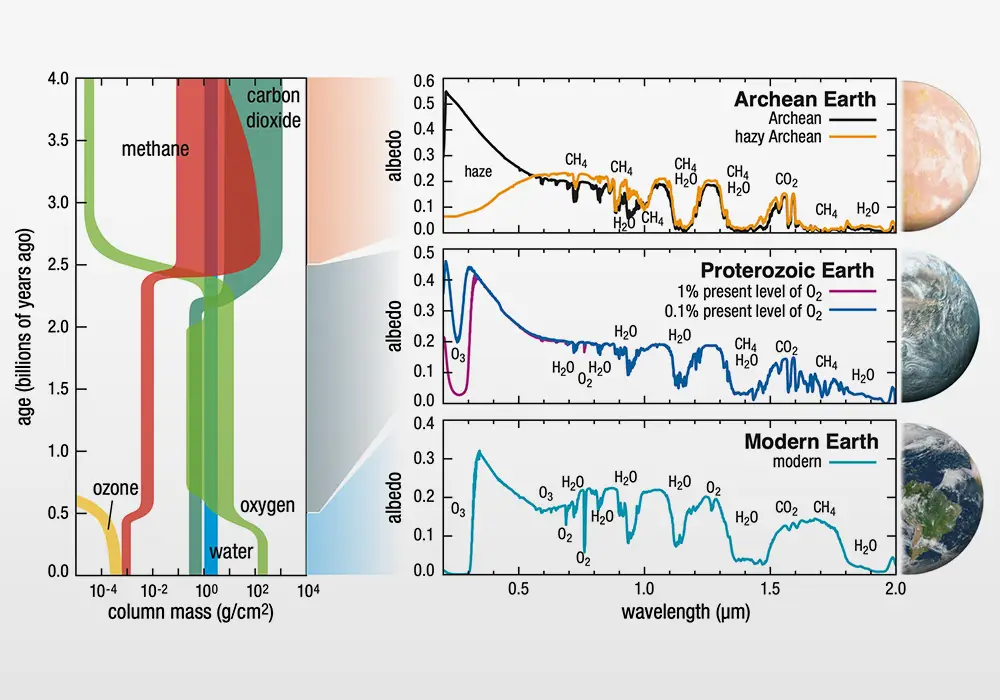
Concentration of oxygen, carbon dioxide, methane, ozone, and water vapor in the Earth’s atmosphere over the past 4 billion years (at left) and corresponding reflected sunlight spectrum of the Earth’s atmosphere during the Archean, Proterozoic, and Modern eons (at right)
Credit: NASA
Challenges to measuring the spectra of exoplanets
There are two main challenges to measuring the spectra of exoplanets:
- The light intensity from the host star is about ten billion times brighter than the exoplanet.
- Seeing Earth-like exoplanets around Sun-like stars is analogous to trying to see a firefly next to a bright searchlight from a long distance.
- The host starlight must be suppressed by a factor of 10 billion (1010) to be able to see and study the exoplanet.
- Even if all light from the host star can be eliminated, the exoplanet light is very faint.
- Earth-like exoplanets are about 30th magnitude, more than 10 billion times fainter than the faintest star that can be seen with the naked human eye. 30th magnitude is equivalent to the faintest galaxies being studied by JWST.
- About 140 spectral channels need to be measured over the 0.2-1.8 µm band to be able to properly measure the spectrum of an exoplanet atmosphere.
- The exoplanet light collected by a 7-meter telescope will be about one photon per sec, for all wavelengths from 0.2 to 1.8 µm.
- The Habitable Worlds Observatory will need to integrate for days and in some cases weeks to accumulate an exoplanet spectrum with sufficient signal-to-noise ratio.
Light from an exoplanet gets fainter the farther the exoplanet is from Earth; intensity reduction is proportional to the square of the distance from Earth. So, it is easier to study nearby exoplanets. Also, the HWO mission can be accomplished more easily by larger telescopes. More light is collected by larger telescopes; a larger telescope can take measurements faster and enable HWO to see more distant exoplanets. The value of larger telescope aperture is shown in the animation below that simulates the volume of space around the Earth that can be studied with 5-meter, 10-meter, and 20-meter HWO telescopes.
- A 5-meter aperture will not be large enough for HWO to achieve its primary science goal.
- At least a 6-meter aperture is required.
- A 10-meter aperture will be able to study exoplanets within ~90 light-years of Earth. With a 10-meter aperture, there are plenty of targets available for HWO to be able to achieve its primary goal of finding and studying at least 25 potentially habitable worlds around other stars.
3-D Animation of stars within 200 light-years of Earth and the number of stars with potentially habitable planets and Earth-like planets observable with 5-meter, 10-meter, and 20-meter space telescopes
Larger telescope apertures can study more distant objects with sufficient signal-to-noise ratio.
Credit: NASA / Space Telescope Science Institute
There is a very important aspect of HWO operation that will be different from other space telescopes. Either space telescopes are tasked to make surveys of the sky, or the telescopes are directed to point at specific objects as follow-up to previous observations made by ground-based telescopes or other space telescopes. HWO is unique in that there is no other telescope that can provide objects to HWO for follow-up. HWO must both find Earth-like exoplanets with an imaging camera, and then follow-up with spectroscopic observations to determine if the exoplanet’s atmosphere has a biosignature that shows signs of life. This is because HWO will be the first telescope that will be able to suppress host starlight enough to be able to see Earth-like exoplanets. No other telescope (not even the Roman Space Telescope) will have a coronagraph that can suppress starlight by a factor of a billion or more.
HWO Telescope - Exploratory Analytic Cases
To structure the development of concepts for the HWO telescope and instrumentation, NASA is developing “strawman” designs that are termed Exploratory Analytic Cases, or EACs for short. These conceptual designs are used to explore the HWO trade space and identify key technology gaps and explore key architectural options and breakpoints. The EACs will be used to develop predictions of observatory performance and the science that can be achieved. NASA does not expect any of the EACs being studied now will be the HWO baseline design; the EACs are only intended to explore and practice. For the telescope, the three EACs that have been put forward to date are shown in the following figure.
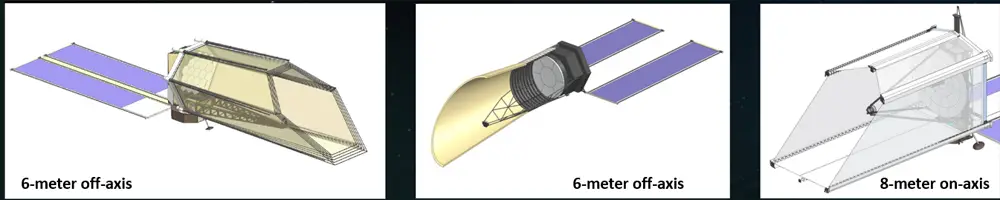
Exploratory Analytic Cases for the HWO telescope
Left – EAC1: 6-meter inner diameter, 7.2-meter outer diameter primary mirror composed of 19 hexagonal segments, similar to JWST. The primary mirror reflects light to an off-axis secondary.
Middle – EAC2: 6-meter round with 7 segments and off-axis secondary.
Right – EAC3: 8-meter primary comprised of 34 segments with an on-axis secondary mirror in front of the primary.
Credit: NASA
NASA is focusing effort now on EAC1 (at left in the figure above), but all three EACs will be studied in due course. For EAC1, NASA has determined two things:
- The telescope, baffle, and solar panel can be folded to fit into the fairings of Starship, New Glenn, and the Space Launch System.
- A relatively straightforward deployment concept has been formulated.
All three of the telescope EACs incorporate a segmented primary mirror. The segmented mirror approach has several advantages:
- Utilizes lessons learned from JWST.
- The smaller mirror segments are much stiffer and have higher resonance frequency than a large monolithic mirror, which is better for wavefront stability.
- The segmented mirror approach enables modification of the primary mirror diameter later in the design process.
HWO Key Technologies and Instrument Suite
The Habitable Worlds Observatory requires a coronagraph that can suppress the exoplanet’s host starlight by a factor of 10 billion (1010). This is one of the primary challenges to developing HWO. The most advanced coronagraph made to date is the Roman Space Telescope’s coronagraph that has achieved starlight suppression by a factor of 200 million (2×10⁸). For the HWO coronagraph to work properly, the wavefront stability of the optics must be on the order of 10 picometers (1×10-11 meters) over a wavefront control cycle. 10 picometers is about one-tenth the diameter of a hydrogen atom. The HWO wavefront stability needs to be about 1000 times better than what has been achieved by JWST. This level of precision can only be accomplished and stabilized with a precise, multi-level adaptive optics system with a feedback loop that operates up to 1000 times per second. The RST coronagraph is a pathfinder for HWO. RST is the first space telescope to use real-time adaptive optics to support a high contrast coronagraph.
There is concern about whether high contrast coronagraphy can be achieved with a segmented primary mirror. The Space Telescope Science Institute (STScI) - on the campus of Johns Hopkins University in Baltimore, Maryland - has established a laboratory to study the effect of segmented primary mirrors and STScI has achieved suppression of host starlight by a factor of 16 million (contrast ratio of 6×10⁻⁸) with a system that operates in air. Since air can easily distort the wavefronts of light, developments are underway to test segmented mirror coronagraphs in a vacuum to assess limits on achievable contrast.
The first-generation instruments for HWO are foreseen to be passively cooled, to minimize risk. Second generation instrumentation, installed later by robotic servicing, may use superconducting detectors that require cryo-coolers to reach temperatures of 1K to 4K. The attraction of superconducting detectors is that they can detect the wavelengths of individual photons. If these detectors can achieve spectral resolution of ~140 in the visible and ~70 in the infrared, the superconducting detectors will eliminate the need for the optics of an Integral Field Spectrograph. The detector becomes the spectrometer. Since spectrograph optics typically have a throughput of about 35%, a superconducting detector could increase the optical efficiency of HWO by a factor of 3, which is equivalent to increasing the telescope primary mirror diameter by 70%.
The first-generation instruments included in EAC1 are largely leveraged from LUVOIR, HabEx, and the Roman Space Telescope:
- Coronagraph / Integral Field Spectrograph – High Contrast Imaging and Spectroscopy
- 10 billion (1010) suppression of host starlight, also referred to as contrast of 1×10⁻¹⁰
- Operates over 350–1800 nm (0.35–1.8 µm)
- Achieves spectral resolution (λ/Δλ) of ~140 in the visible and ~70 in the near infrared
- High Resolution Imager – UV/Visible and Near Infrared Imaging
- Operates over ~200–2500 nm (0.2–2.5 µm)
- Field of view of 3 × 2 arcmin
- ~67 science filters and grism (combination of a grating and prism)
- UV Multi-Object Spectrograph – UV/Vis multi-object spectroscopy and Far UV imaging
- Operates over ~100–1000 nm (0.1–1.0 µm)
- Field of view of 2 × 2 arcmin
- Selects objects to study with a microshutter array of 840×420 subapertures. Each subaperture is about 100 × 200 µm in size (similar to what is used in JWST NIRSpec).
- Achieves spectral resolution (λ/Δλ) of 500–50,000
NASA is also planning for a fourth instrument to be installed, an instrument which could potentially be supplied by an international partner.
HWO Instrument Focal Plane Array (FPA) Requirements
Due to the extremely low light level of exoplanets, the Integral Field Spectrograph (IFS) of the high contrast Coronagraph must incorporate true photon counting detectors that have zero noise, i.e. zero readout noise and effectively zero dark current. True photon counting detectors do not yet exist at the level of performance required by HWO.
- The electron-multiplied CCDs (EMCCDs) that are used in the Roman Space Telescope coronagraph can detect individual photons but EMCCDs have inherent noise that limits the EMCCDs’ ability to distinguish multiple photon detections within a single pixel. The closest technology demonstrated for UV/Visible are “skipper CCDs” that read the photoelectrons of a standard CCD several times, “skipping” the charge on and off the gate of the MOSFET amplifier hundreds of times to average down the readout noise to sub-electron performance.
- In the near infrared, HgCdTe electron-avalanche photodiodes have achieved single photon counting but do not yet have the low dark current and multiple photon counting performance required by HWO.
Visible and infrared detector technologies are already well-developed that can meet the needs of the High Resolution Imager (HRI). In the infrared, HRI can use the large format detectors that are in the Roman Space Telescope, 4K×4K pixel H4RG-10. For the HWO HRI, the H4RG-10 could be improved by modifying the readout integrated circuit (ROIC) to reduce readout noise. In the UV/Visible, there are large format CMOS devices now being made for space that have the formats (# pixels, pixel pitch) required by HRI. These CMOS FPAs need to be improved with a UV-optimized backside processing to achieve the UV quantum efficiency needed for the HRI UV/Visible channel.
The UV Multi-Object Spectrograph can make use of the photon counting UV/Visible detectors developed for the Integral Field Spectrograph.
The design of the HWO telescope and instrumentation is at a very early stage, and the formats and performance of visible and infrared focal plane arrays (FPAs) are not well-defined. But to provide information to the EACs being developed for the telescope and instrumentation, a strawman set of requirements for the FPAs for the first generation HWO instruments is presented in the table below.
“Strawman” specifications for visible and infrared focal plane arrays needed by EAC-1 instrumentation.
This list is for the first generation, passively cooled instrumentation.
The most challenging specifications are shown in bold maroon font.
Light from the high contrast Coronagraph is fed to the Integral Field Spectrograph.
Compiled by Teledyne based on NASA documentation presented at the HWO START/TAG meetings.
| Wavefront Sensor |
Visible |
Infrared |
Comments |
| Number of FPAs |
2 |
2 |
To be reviewed |
| Format (# pixels) |
128 x 128 |
128 x 128 |
To be reviewed |
| Pixel Pitch (µm) |
13 |
TBD |
To be reviewed |
| Frame Rate (Hz) |
> 1000 ? |
> 1000 ? |
> 1 kHz frame rate? |
| Readout Noise (e-) |
< 0.1 ? |
< 0.1 ? |
Photon Counting? |
| High Resolution Imager |
Visible |
Infrared |
Comments |
| Focal Plane Mosaic size (# pixels) |
24K x 16K |
8K x 12K |
Based on LUVOIR-B HDI |
| Number of FPAs |
2x3 |
2x3 or 2x2 |
|
| Format of individual FPA (# pixels) |
8K x 8K |
4Kx4K or 6Kx4K |
Can reduce readout noise with a new IR ROIC design |
| Pixel Pitch (µm) |
6.5 |
10 |
To be reviewed |
| Frame Rate (Hz) |
> 1 |
> 1 |
|
| Operating Temperature (K) |
140 - 168 K |
65K, 50K is goal |
|
| Readout Noise (e-) |
< 0.1 ? |
< 0.1 ? |
Photon Counting required? |
| Integral Field Spectrograph |
Visible |
Infrared |
Comments |
| Number of FPAs |
2 |
2 |
|
| Format (# pixels) |
4K x 4K |
2K x 2K |
|
| Pixel Pitch (µm) |
TBD |
TBD |
|
| Frame Rate (Hz) |
> 1 |
> 1 |
|
| Readout Noise (e-) |
< 0.1 |
< 0.1 |
Photon Counting |
| Operating Temperature (K) |
140 - 168 |
65K, 50K is goal |
Zero dark current |
| UV Multi-Object Spectrograph |
Visible |
Infrared |
Comments |
| Number of FPAs |
TBD |
Not required |
To be defined |
| Format (# pixels) |
> 8K x 8K |
Not required |
To be reviewed |
| Pixel Pitch (µm) |
TBD |
Not required |
|
| Frame Rate (Hz) |
> 1 |
Not required |
|
| Readout Noise (e-) |
< 2.5 e- |
Not required |
|
| Operating Temperature (K) |
140 - 168 |
Not required |
|
| Quantum efficiency |
≥ 40% for 100-400 nm |
not required |
≥ 80% for 400-1000 nm |
While requirements will be refined during the next years, several observations can be made:
- True photon counting FPAs (no noise – no readout noise, no dark current noise) are required for the Integral Field Spectrograph. This is one of the key HWO technology developments.
- The format and performance of wavefront sensor detectors are ill-defined since the range of light levels to be detected and frame rate are not well-known (at least by Teledyne).
- The High Resolution Imager FPAs may be available from existing technology.
- The UV Multi-Object Spectrograph will need to make use of the “delta-doping” technology developed by the Jet Propulsion Laboratory to achieve high quantum efficiency down to 100 nm.
Animation of HWO Performance
If the required technologies are successfully matured and integrated, the images of nearby exoplanets produced by the HWO Coronagraph may look like this animation that simulates HWO imaging our Solar System from a distance of 10 parsec (33 light-years).
Animation of the images that a fully operable HWO Coronagraph would take of our
Solar System from a distance of 10 parsec (33 light-years)
The planets appear larger than actual size due to the diffraction-limited resolution of the telescope.
Credit: NASA / Space Telescope Science Institute.

